ePortfolio
Introduction
Hello,
I’m Yana Burlak, a Computer Science student at SNHU. This ePortfolio presents my work enhancing the PetBag Boarding and Grooming System through three phases: Software Design and Engineering, Algorithms and Data Structures, and Databases. The original project began as a simple console-based Java program in IT-145 Foundation in Application Development. Throughout these phases, I transformed it into a full-featured, GUI-based application with persistent storage, more advanced business logic, and secure authentication.
Each phase challenged me to revisit knowledge from previous courses and expand my understanding by learning new approaches and improving my development practices.
I selected this artifact for my ePortfolio because it represents a complete and meaningful project that demonstrates my ability to design and develop a full-stack application from start to finish. The PetBag Boarding and Grooming System shows my growth as a developer, especially as the project evolved beyond basic functionality into a more secure and structured application.
Professional self-assessment
When I first started at Southern New Hampshire University, I honestly did not fully understand what earning a degree in computer science would demand from me. I saw it as an opportunity, but I didn’t yet see the discipline, persistence, and long sleepless nights that would come with it. Three years later, after challenges, frustration, and growth, I can confidently say that this journey shaped me both technically and personally.
Online learning is often criticized for lacking interaction, and at times it can feel isolating. However, through weekly discussions, peer responses, and collaborative assignments, I still felt connected to a diverse community of students across the country. Those interactions helped me strengthen my communication skills and reminded me that software development is never just about code, it is about people working together to build something meaningful.
Several courses had a lasting impact on me.
CS-250 (Software Development Lifecycle) was the first course where I truly understood the importance of collaboration. Learning about Agile and Scrum showed me how structured teamwork leads to better outcomes. It changed the way I see development not as an individual task, but as a shared responsibility.
CS-210 (Programming Languages) helped me appreciate the diversity of programming languages. I realized that as a developer, flexibility matters. There is rarely one “perfect” solution, and choosing the right tool for a specific problem requires both knowledge and judgment. This course also reinforced that writing code means writing it well, clean, efficient, and professional.
CS-305 (Software Security) deeply influenced how I think about security. Before this course, I viewed security as an added feature. Now I understand it as a foundation. Learning about encryption, hashing, and secure communication made me realize how easily vulnerabilities can appear if security is treated as an afterthought.
In CS-300 (Analysis and Design), I learned to slow down and think critically about algorithms and data structures. Instead of focusing only on whether something works, I began asking whether it works efficiently and optimally. That shift in thinking strengthened my analytical skills.
CS-465 (Full Stack Development) brought everything together. It helped me see how front-end and back-end systems must work seamlessly to create a complete application. I especially enjoyed this course because it showed me that problem-solving in programming is creative. There are multiple paths to a solution, and growth comes from research, experimentation, and persistence.
My Capstone project reflects these lessons.
I demonstrated collaboration by designing an application that could realistically be used and maintained by multiple users or developers. I applied communication skills through clear documentation, consistent commenting, and an intuitive Tkinter interface that prioritizes user experience.
From a technical perspective, I used algorithmic thinking to solve practical problems such as occupancy tracking and pricing calculations. I considered trade-offs between clarity, efficiency, and maintainability when making design decisions.
I also applied industry-relevant tools and practices, including Python development, structured database design, and CRUD operations. Most importantly, I approached development with a security mindset, implementing input validation, user authentication, and secure database queries to prevent vulnerabilities like SQL injection.
Looking back, I can see how much I have grown. I no longer approach projects just trying to make them work. I think about design choices, performance, security, and long-term maintainability. I understand that secure and thoughtful development is not optional, it is a responsibility.
Overall, I believe I have met the program outcomes and, more importantly, developed the mindset of a professional ready to continue learning and improving in the field of computer science.
This foundation prepared me for the technical work ahead. Below, you can watch my initial code review and explore how I transformed the PetBag Application through three enhancement phases
CODE REVIEW
Before starting the enhancements, I recorded a code review of the original Java application. In the video, I discussed its main limitations, including the lack of persistent storage, flat grooming pricing, no graphical user interface, and minimal error handling. You can watch the review here:
ORIGINAL CODE & USER VIEW
The original PetBag Application was a command‑line program that prompted the user with a series of questions to accept a pet into the facility. Here’s a screenshot of the interaction and link to the orginal code:
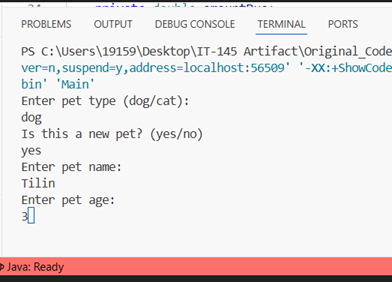
The program ran as expected, but it was not practical or professional enough for a small boarding business. For that reason, it became an ideal choice for my capstone project.
ENHANCEMENTS
Phase One: Software Design and Engineering
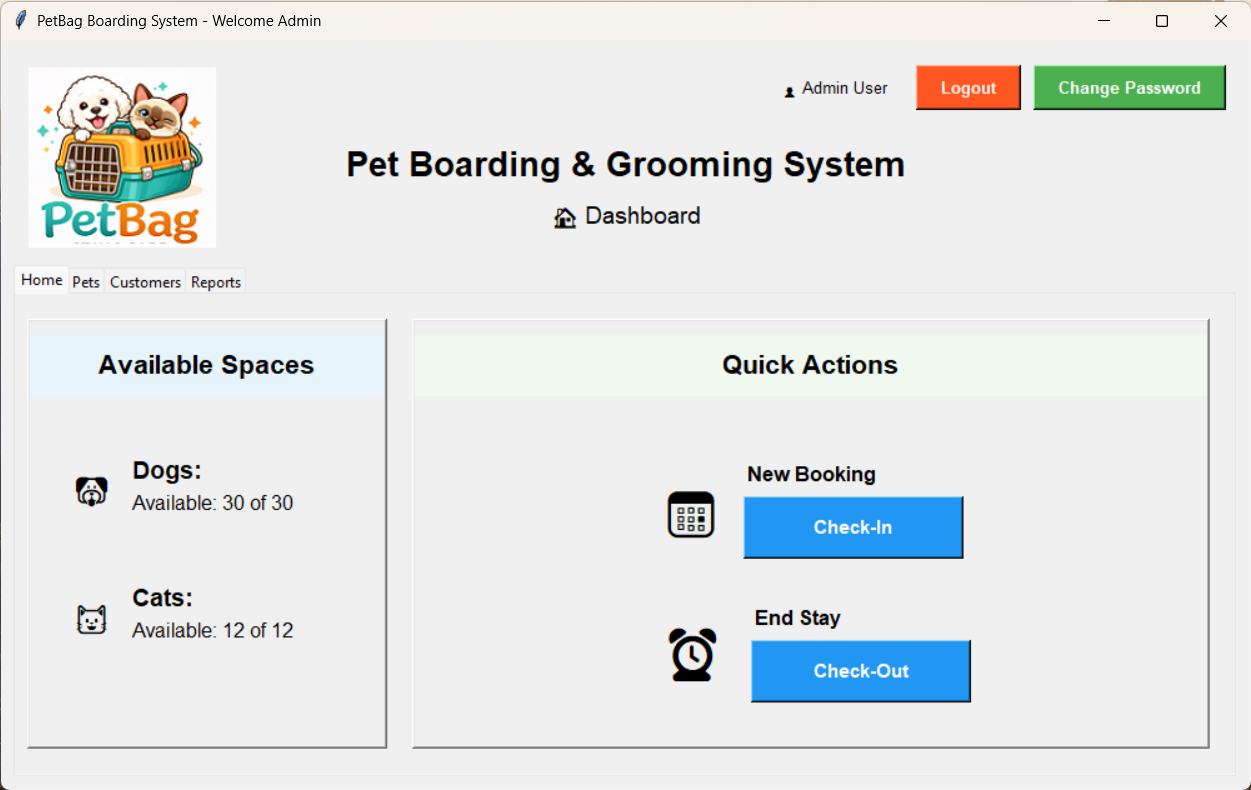
My main goal for this phase was to migrate the application from Java to Python, build an intuitive graphical interface, and introduce a persistent database. I wanted to create a foundation that could support more complex features later.
Screenshot of the PetBag Boarding & Grooming system’s GUI, built using Python and Tkinter:
Programming Language
I chose Python because of its rich ecosystem (Tkinter for GUI, mysql‑connector for database) and its readability, perfect for a project that would grow over time. Plus, Python’s dynamic nature made it easy to prototype and refactor.
The application was designed with small business owners in mind. It runs as a standalone system without the need for complex infrastructure or web hosting, making it a practical and cost-effective solution.
GUI with Tkinter
I used Tkinter to create a tabbed interface (ttk.Notebook) with four main tabs: Home, Pets, Customers, and Reports. Each tab contains relevant widgets: Treeview for displaying data, Entry and Combobox for input, and Button for actions. The Treeview widget was perfect for displaying lists of customers and pets, and binding double‑click events allowed editing directly.
Basic Database Setup
I designed a relational database named pet_bag_db with four tables (Users table would be created later):
- Customer,
- Pet,
- Boarding,
- Grooming.
The setup script (database/setup.py) creates these tables if they don’t exist.
Here’s a snippet that creates the Boarding table:
cursor.execute("""
    CREATE TABLE IF NOT EXISTS Boarding (
        boarding_id INT AUTO_INCREMENT PRIMARY KEY,
        pet_id INT NOT NULL,
        check_in DATE NOT NULL,
        check_out DATE,
        days_stay INT NOT NULL,
        amount_due DECIMAL(10,2) NOT NULL,
        grooming_requested BOOLEAN DEFAULT FALSE,
        FOREIGN KEY (pet_id) REFERENCES Pet(pet_id)
        ON DELETE CASCADE
    )
""")
I used ON DELETE CASCADE to automatically remove boarding records when a pet is deleted, this ensures data integrity without manual cleanup.
Each model class, including Customer and Pet, was provided with basic CRUD methods to support record creation, modification, and retrieval. Proper cascade deletion still required work and was scheduled for implementation in the next enhancement phase.
By the end of Phase 1, I had a working application with a clean interface and a solid database foundation that met some of the initial requirements of the CS‑499 capstone project.
Phase Two: Algorithms and Data Structures
In this enhancement phase, I wanted to add intelligent business logic: dynamic grooming pricing, real‑time space tracking, comprehensive reporting, and a proper architectural separation. This required careful algorithm design, the use of appropriate data structures, and refactoring into the MVC pattern.
Data Structures
Throughout this phase, I used:
- dictionaries for pricing tiers, configuration, and row data from the database.
- lists for dropdown values (age, days stay, report periods).
- tuples for parameterized SQL queries.
MVC Architecture
I refactored the code into Models, Views, Controllers, and Services:
- Models (customer.py, pet.py) – encapsulate data and CRUD operations.
- Views (views.py) – handle all GUI components and user interaction.
- Controllers (controllers.py) – coordinate between models and views, containing high‑level workflow logic.
- Services (boarding_service.py, checkout_service.py, report_service.py) – complex business rules, separate from controllers.
This separation made the code much easier to maintain and test.
Grooming Pricing Tiers
The original Java version charged a flat $50 for grooming, regardless of dog size. I introduced weight‑based pricing using a dictionary of dictionaries that maps weight ranges to prices.
Here’s a snippet with new pricing:
GROOMING_PRICES = {
    'small':   {'min': 2,   'max': 20,  'price': 50},
    'medium':  {'min': 21,  'max': 50,  'price': 70},
    'large':   {'min': 51,  'max': 100, 'price': 90},
    'extra_large': {'min': 101, 'max': float('inf'), 'price': 110}
}
The calculate_grooming_price(weight) method iterates through the tiers to find the matching range:
def calculate_grooming_price(weight):
    if weight < 2:
        return 0  # too small for grooming
    for tier, details in BoardingService.GROOMING_PRICES.items():
        if details['min'] <= weight <= details['max']:
            return details['price']
    return BoardingService.GROOMING_PRICES['extra_large']['price']
This simple loop has a time complexity of O(n), but since n is very small, performance is not an issue. The real advantage lies in maintainability: if the business owner decides to change prices, you only need to update the dictionary.
Space Availability Tracking
To know how many spaces are available, I needed to count active boardings. I added a method in pet.py that queries the database for pets with no checkout date:
def get_occupied_spaces(db):
    cursor = db.connection.cursor()
    cursor.execute("""
        SELECT p.pet_type, COUNT(*) as count
        FROM Boarding b
        JOIN Pet p ON b.pet_id = p.pet_id
        WHERE b.check_out IS NULL
        GROUP BY p.pet_type
    """)
    results = cursor.fetchall()
    occupied = {'dog': 0, 'cat': 0}
    for pet_type, count in results:
        occupied[pet_type.lower()] = count
    return occupied
Available spaces are then calculated by subtracting these occupied counts from the total capacity (e.g., dog_spaces = 30 - occupied[‘dog’]). This real‑time calculation ensures users always see accurate capacity on the dashboard.
Check-In & Check-Out
At the core of PetBag Boarding System are two essential workflows: checking pets in and checking them out. I focused on making these processes clear and efficient because they directly impact space availability, revenue, and the data used for reporting. The dialogs I designed guide staff through each step, validate inputs, and provide immediate feedback. Everything else customer records, pet management, and reports supports or builds upon these core events. By ensuring these workflows are intuitive and reliable, I created a system that works smoothly in a busy boarding environment.
When the user clicks “Check‑In” on the Home tab, a dialog appears with fields for owner information, pet details, and stay preferences. The system validates every input, checks for available space, calculates charges (including grooming if requested), and creates the necessary database records. A success message summarizes the charges, and the dashboard updates in real time.
For checkout, another dialog lists all currently boarded pets. After selecting a pet, staff can view details, calculate the total, and either confirm checkout or generate an invoice. Upon confirmation, the boarding record is updated, the space is freed, and an invoice can be viewed or saved.
A screenshot of the check‑out dialog:
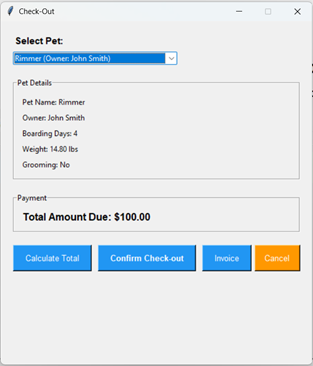
These two dialogs form the operational core of the application. Every other feature exists to support or analyze the data generated by these check-in and check-out events.
Reporting
The report_service.py contains two major methods: get_occupancy_report and get_revenue_report. Both use SQL aggregation functions to summarize data over a user‑specified period (7, 30, 60, or 90 days).
Here’s a snippet of the revenue report:
SELECT
    DATE(b.check_in) as date,
    COUNT(*) as total_boardings,
    SUM(b.amount_due) as daily_revenue,
    SUM(CASE WHEN p.pet_type = 'dog' THEN b.amount_due ELSE 0 END) as dog_revenue,
    SUM(CASE WHEN p.pet_type = 'cat' THEN b.amount_due ELSE 0 END) as cat_revenue,
    SUM(CASE WHEN b.grooming_requested = 1 THEN 1 ELSE 0 END) as grooming_count
    -- (Grooming revenue from Grooming table omitted for brevity)
FROM Boarding b
JOIN Pet p ON b.pet_id = p.pet_id
WHERE b.check_in BETWEEN %s AND %s
GROUP BY DATE(b.check_in)
A similar CASE expression (combined with a JOIN to the Grooming table) calculates grooming revenue; the core technique of conditional aggregation is demonstrated above. This query separates dog revenue, cat revenue, and grooming requests using conditional aggregation. The results are then formatted into a readable text report.
Below is a sample revenue report generated by the application:
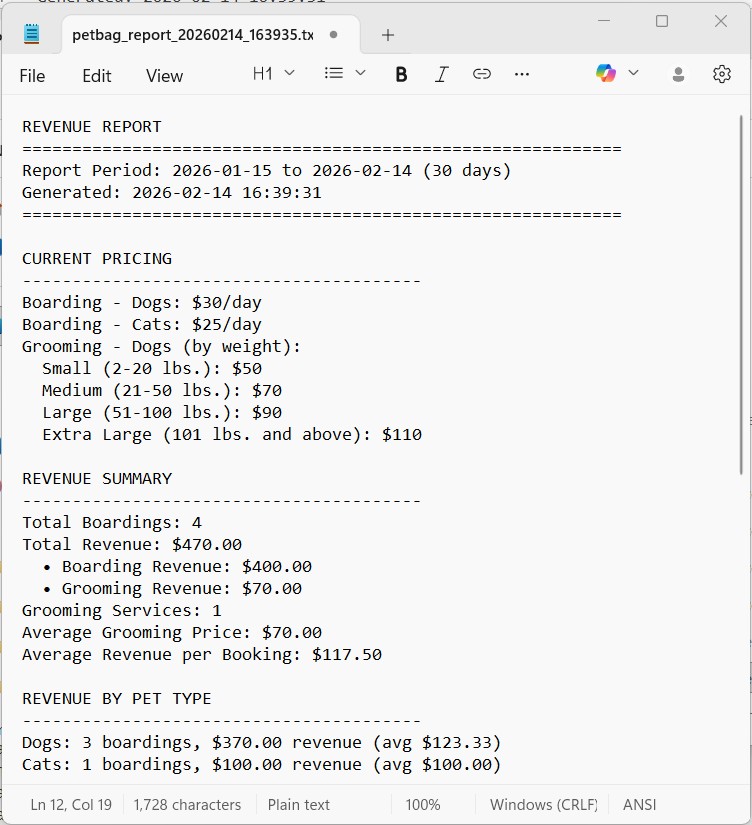
By the end of Phase 2, the application had a clean MVC structure and robust business logic.
Phase Three: Databases
The final phase focused on strengthening the database design, adding user authentication, and implementing security measures. I also introduced a UML class diagram to document the schema. I added the Users table, moved configuration to environment variables, and added thorough input validation on all data entry forms.
UML Class Diagram
To document the database schema and relationships, I created a UML class diagram. It shows the five tables, their attributes, and foreign key connections. You can view the full PDF here:
Users Table
To support authentication, I added a Users table to the pet_bag_db.
Below is the SQL script for creating the Users table:
CREATE TABLE IF NOT EXISTS Users (
    user_id INT AUTO_INCREMENT PRIMARY KEY,
    username VARCHAR(50) UNIQUE NOT NULL,
    password_hash VARCHAR(255) NOT NULL,
    email VARCHAR(100),
    first_name VARCHAR(50),
    last_name VARCHAR(50),
    is_active BOOLEAN DEFAULT TRUE,
    created_at TIMESTAMP DEFAULT CURRENT_TIMESTAMP,
    last_login TIMESTAMP NULL,
    password_changed_at TIMESTAMP NULL
);
User Authentication
I developed a login window to support authorized access to the application. Passwords were secured using SHA-256, and each login session was set to time out after 30 minutes. Below is the user login screen:
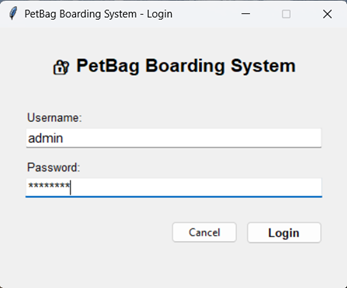
The auth_service.py handles initial login and password changes. Passwords are hashed using SHA‑256. Here’s the snippet of authentication method:
def authenticate_user(db, username, password):
    cursor = db.connection.cursor(dictionary=True)
    cursor.execute("SELECT * FROM Users WHERE username = %s AND is_active = TRUE", (username,))
    user = cursor.fetchone()
    if not user:
        return None, "Invalid username"
    password_hash = hashlib.sha256(password.encode()).hexdigest()
    if user['password_hash'] == password_hash:
        # update last_login
        cursor.execute("UPDATE Users SET last_login = CURRENT_TIMESTAMP WHERE user_id = %s", (user['user_id'],))
        db.connection.commit()
        return user, "Login successful"
    else:
        return None, "Invalid password"
The login_window.py script collects user credentials and calls the authentication method. Once login is successful, the user object is passed to the main application, which opens the main window. From there, the user can manage all tasks, including checking in pets, ending stays, generating reports, and modifying or deleting records.
Security Measures
Multiple security measures were addressed in this enhancement phase:
- Environment Variables: Database credentials are stored in .env and excluded from version control.
- Parameterized Queries: SQL uses placeholders, preventing SQL injection.
- Input Validation: All user inputs are validated before use.
- Password Hashing: SHA‑256.
- Session Management: A SESSION_TIMEOUT constant is defined for future use.
Overall, security standards were met, and testing from a user perspective showed the application performed well.
CONCLUSION
This capstone project was an excellent learning experience: I transformed a simple Java console program into a full‑stack Python application with a GUI, relational database, and authentication. I applied skills in software design, algorithms, and database management, and gained hands-on experience with language migration, MVC architecture, dynamic pricing, reporting, and input validation. The final product is fully functional and could be confidently used by a small pet boarding business.